

Which Programming Language Should I Learn First?
Choosing the Right Language for You
Each programming language has its strengths—what's best for you depends on what you want to build.
- Just getting started? Try Python. It's simple, readable, and perfect for beginners.
- Interested in websites? Go with HTML to learn how web pages are built.
- Want to build Android apps or games? Java is your go-to.
- Love performance and control? Check out C++, especially for gaming or system software.
Think about your goals, then choose the language that fits—and remember, once you learn one, picking up others gets easier! Check out our pros and cons for each language down below to help you decide which language is the best fit for you!
Not Sure Where to Start?
Take this quick quiz to find your perfect coding match!
-
What excites you most?
- A) Building my own website
- B) Making games or high-performance apps
- C) Creating mobile apps or tools for work
- D) Automating tasks and analyzing data
-
How much coding experience do you have?
- A) None at all!
- B) A little—I like a challenge
- C) I've dabbled in some code
- D) I want something simple to start with
-
What's your dream project?
- A) A personal portfolio or blog
- B) A video game or desktop software
- C) A mobile app or business tool
- D) A smart script that saves me time
Results:
- Mostly A's? Start with HTML — it's your gateway to web development.
- Mostly B's? Dive into C++ — perfect for game and software enthusiasts.
- Mostly C's? Try Java — ideal for app builders and future professionals.
- Mostly D's? Go with Python — it's easy to learn and endlessly useful.
- A mix? Go with Python — it's beginner friendly and incredibly versatile.
Flowchart Guide to Picking a Coding Language
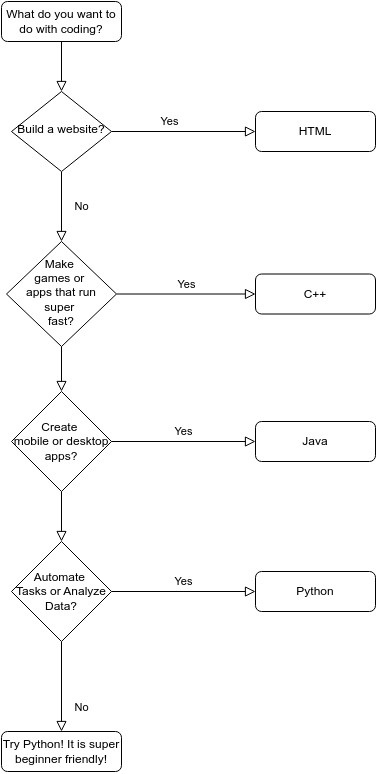
Language Comparison Chart
| Language | Syntax Difficulty | Common Use Cases | Best For | Learning Curve |
|---|---|---|---|---|
| Python | Very Easy | Web apps, data science, automation | Beginners and rapid development | Smooth and simple |
| HTML | Very Easy | Building website structure | Web development starters | Very beginner friendly |
| Java | Moderate | Android apps, games, enterprise tools | App development and career growth | Steeper but rewarding |
| C++ | Harder | Game Engines, system software | Performance-heavy applications | Challenging but powerful |
Pros and Cons
Python
Pros:
- Very beginner-friendly and easy to read
- Tons of libraries for almost any task
- Great for automation, data science, and web apps
- Cross-platform and highly scalable
- Slower than compiled languages like C++
- Not ideal for mobile or game development
- Can use memory inefficiently
- Multithreading is limited
HTML
Pros:
- Super easy to learn — no coding background needed
- Foundation of all websites
- Works in every browser
- Lightweight and loads fast
- Can't create dynamic features alone (needs CSS/JavaScript)
- Requires lots of manual code for simple designs
- Limited error handling and security
- Content updates can be time-consuming
Java
Pros:
- Strong for mobile apps (especially Android)
- Object-oriented — helps organize complex programs
- Built-in memory management (garbage collection)
- Secure and supports multitasking (multithreading)
- Code can be long and complex
- Uses more memory than other languages
- Slower than low-level languages like C++
- Not the best for real-time or performance-heavy tasks
C++
Pros:
- Extremely fast and powerful
- Great control over system resources
- Widely used in game engines and high-performance software
- Supports reusable, object-oriented code
- More difficult for beginners
- Manual memory management required
- Less forgiving — small mistakes can cause big issues
- Limited built-in features (e.g., no native database support)